top of page

Chemistry
Introduction
Hello, welcome to the Chemistry page. Here, you will learn one of the types of science in science 9. As you progress in science, there will be a lot more content to cover, so science is split into smaller mini subjects, so it makes teaching them more manageable.
In this page, you will learn a shortened form of the things that will be taught in Science/Chemistry 9.
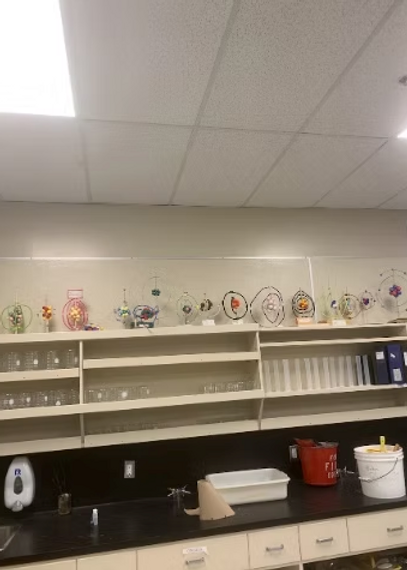
In the science classroom, there are big tables that are to be shared. The size of these tables make it great for doing fun lab experiments, but remember to clean up the test site afterward!
You will also need to learn how to use the tools in the lab.
Lab and safety equipment
-
Beakers, test tubes, and graduated cylinders are used for mixing, heating, and measuring liquids.
-
Microscopes are for viewing small objects and cells.
-
Scales are for measuring mass.
-
Bunsen burners are for heating substances.
-
Safety goggles and lab coats are essential for protecting students' eyes and clothing.
-
Gloves are used for handling chemicals or other materials.
Instructional tools and furniture
-
Whiteboard or chalkboard are used for writing and drawing diagrams.
-
Desks, student desks and a teacher's desk.
-
Calculators are for calculations and data analysis.
-
Storage bins and shelves are for organizing supplies and materials.
General supplies
-
Chemicals and distilled water are for experiments.
-
Notebooks are for recording observations and data.
-
Antibacterial wipes, hand sanitizer, and tissues are for cleanliness.


The Building Block Of Matter
The Atom — The Building Block of Matter
Everything in the universe is made of matter, and all matter is made up of atoms. An atom is the smallest amount of an element which still has the properties of that element.
Atoms are made up of three major subatomic particles:
Protons: Positive particles housed within the nucleus.
Neutrons: Neutral particles also housed within the nucleus.
Electrons: Charged negatively and orbiting around the nucleus within energy levels or shells.
The atomic number tells us about the number of protons in an atom, and in a neutral atom, the number of electrons is equal to the number of protons.
The Periodic Table puts elements in order of increasing atomic number. Each element has a unique chemical symbol and different properties. Atoms need to be comprehended as the way they are put together informs us why elements combine and interact with one another to form what makes up our world — from water to the air we breathe.
Elements, Compounds, and Mixtures
Elements, Compounds, and Mixtures
All that exists around us on our earth can be categorized into elements, compounds, or mixtures.
Elements are chemically pure substances comprised of only one kind of atom. Some examples are oxygen (O), iron (Fe), and gold (Au).
Compounds are formed when two or more elements, in a fixed ratio, combine chemically. Water (H₂O) is a compound of hydrogen and oxygen, whereas carbon dioxide (CO₂) is a compound of carbon and oxygen. The compounds have different properties compared to the elements that make up the compounds.
Mixtures are combinations of materials that are not chemically bound. Mixtures can be homogeneous, in which the composition is uniform, such as salt water, or they can be heterogeneous, with Weight vary in composition, such as trail mix.
In Canadian curriculum, students learn to differentiate mixtures by physical means such as filtration or evaporation and that compounds require chemical changes in order to dissolve. Understanding these differences helps us comprehend how materials behave in the world and in life.

Chemical Reactions
Chemical Reactions — How Substances Change
A chemical reaction occurs when substances interact to form new substances with different properties. During a reaction, atoms are rearranged but no matter is created or lost—this follows the Law of Conservation of Mass.
Signs of a chemical reaction are:
-Colour change
-Gas or heat release
-Formation of a solid (precipitate)
-Release of light or sound energy
The reactants are what you start with, and products are the new compounds formed. For example:
Hydrogen + Oxygen → Water
(2H₂ + O₂ → 2H₂O)
Chemical reactions can also be grouped into categories such as synthesis, decomposition, combustion, and neutralization. Knowing reactions can explain day-to-day phenomena such as cooking, rusting, and photosynthesis.
In Grade 9 chemistry, students study the role of chemical changes in our world and how to apply this knowledge in environmentally beneficial manners—such as producing cleaner fuel and recycling waste properly.

Conclusion
In short, the chemistry 9/10 class will teach you about atoms, chemical reactions, elements, and how compound mixtures work!
Now this is what you need to know about Palmer's chemistry 9/10
Whether you want to learn about Palmer's chemistry 9 course, or just here to take a look at things, I hope you learned a lot about what Palmer's chemistry course has to offer.

bottom of page